...all about ASCUS

ASCUS creates a space for those wishing to re-interpret or re-mould the way that individuals and the public engage with art and science. As an organisation we facilitate connections between these two, seemingly disparate, worlds and aim to foster a creative and boundary-pushing dialogue between scientists and artists. As well as supporting the creation of art-science collaborative work we host lectures, workshops and events for anyone with an interest in either discipline, who wishes to see what this exciting fusion of ideas and methods can produce. Our work also spans beyond this to include aiding public engagement with science and innovation through art-science teaching and training. See our website to find out more: www.ascus.org.uk.

Read on to discover what happens when ASCUS goes to...

Showing posts with label ASCUS. Show all posts

Tuesday, 8 October 2013

ASCUS goes to...the British Science Festival

At the beginning of September, scientists from across the UK and beyond descended on the city of Newcastle for this year’s British Science Festival. From 7th to the 12th September, the city became home to pop-up labs, science street buskers, debates, workshops and exhibitions designed to educate, engage and inspire visitors of all ages and interests.

Much to our great pleasure, artiscience (the discipline of art-science collaboration) seemed to feature prominently in this year’s Festival. From family-friendly arts and crafts to a national conference for artiscience practitioners, visitors were encouraged to explore the role of art-science collaborations in science communication from a public, artistic and scientific perspective.

As this exciting world of artiscience continues to develop and evolve, there is a growing rejection of the somewhat exploitative use of art as an instrumental or illustrative device to interpret science. Rather, an appreciation of the common characteristics of art and science as performative approaches to producing knowledge is beginning to be cultivated.  It was on this theme that the BSF centred its art-science Symposium and Networking Day on the 9th September, as well as the Festival’s artiscient exhibition Extraordinary Renditions: the cultural negotiation of science.  Hosted by the BALTIC Centre for Contemporary Art, the exhibition featured work by artists from BxNU, a research institute birthed from the partnership between the BALTIC and Northumbria University.  Although unique in their renditions and interpretations, the artists each sought to challenge the all-too-common segregation of specialist knowledge by presenting a rendition of science outside of its traditional and technical parameters.

On the theme of commonalities and the production of knowledge, the work of Chris Dorsett stood out as particularly illuminating. Dorsett’s central aim is to explore, from the perspective of exhibition practice, the interface between contemporary art and museum collections. This focus has produced artworks and curational experiments that rethink museological claims about the construction of knowledge through the display and interpretation of objects. While mulling these heady concepts, Dorsett regularly meets geneticist Volker Straub and David Elliott (both of the Institute of Genetics Medicine, Newcastle University) on their local commuter train. His contribution to Extraordinary Renditions revealed the remarkable value of their seemingly unremarkable conversations.  

In the format of short fragmentary films, Dorsett shared the lessons they had learned about the similarities between DNA and museum collections through their discussions of their work. Museums, like genes, have traffic between storage and display. Museums, like proteins, are created when things they have been inaccessible become expressed. At the heart of their discussions was the role of archival information on the expression of meaning. According to Straub and Elliott, there is a growing appreciation amongst geneticists that the presence of previously labelled ‘junk’ DNA (that is, DNA sequences which do not encode proteins and which have therefore been considered relatively unimportant by scientists) is in fact vital for the meaning of the 'useful' protein-encoding DNA. Likewise, that which has been selected for display in a museum is always informed by the unselected, notes Dorsett. Even the processes of art and science were found to bear a certain degree of similarity. When art is displayed, Dorsett explains, there are the unfathomable remains of what has been left behind before the artist is finished. Similarly, when a scientific paper is written, there are always a mass of data, of experiments and discoveries, which are left unpublished. 

Despite their expertise and distinction, all three were able to explain the intricacies of their work in a manner that was unassuming and understandable. This accessible collision of two worlds usually renowned for baffling lay audiences with jargon and complexities was a refreshing and inspiring experience. What’s more, the willingness of Dorsett, Straub and Elliott to lay aside technical terminologies and bring themselves to a common level of understanding has facilitated the production of new knowledge that neither their science nor art alone would have achieved.


It seems there is a lot to be gained from the sacrifice of our linguistic barricades. And it seems it is true that the collaboration of artists and scientists can do much more than illustrate existing knowledge. There are so many new insights to be found on common ground.


Sunday, 1 September 2013

ASCUS Goes to... Ecstatic Arc

Robbie Thomson's 'Ecstatic Arc' is a superbly executed marriage between sound design, electro-acoustic composition, sculpture, set-design and visual art to name only a few branches of the arts the project draws from. This performance is not one for the faint hearted, and is sure to divide the opinion of the audience for the remainder of its residence here at the Summerhall venue.


Image courtesy of <http://sonic-a.co.uk/ecstatic-arc/>


Composing the score in a digital audio workstation, Thomson is able to export the music as a MIDI signal, which is used as an impulse generator to trigger the light show and electrical bursts of the Tesla coil in real-time during the performance. This technique forms the crux of the performance, sparking pure blue flashes and bursts of light which cast unnerving shadows across the industrial set, formed from a collection of Thomson's contorted, animalistic kinetic sculptures.
The combination of visual effects and the intensity of the digital score is spectacular, with deafening sub-bass likely to appease even the most hardened electronic music fans in its ability to leave the variety of stage props quivering in its wake. The sporadic movements and acoustic sounds produced directly from the set's kinetic sculptures bring a more organic element to the digital soundtrack. Increasing in intensity the erratic motions and sounds build the composition from meek beginnings to a veritable full-scale sonic warfare launched upon the audience, who are left mesmerised by the dance of the Tesla coil's plasma arcs.


The Ecstatic Arc experience is rooted in its primal, visceral exploration of artistic media. Like the angular, glistening sculptures, the digital score is not rounded and 'normalised' in its form or aesthetic. From a musical perspective, whilst the composition develops linearly to a notable climax, for me the work tails-off aimlessly to meet its resolution. That said, it is balanced through Thomson's alluring rhythmic themes which develop throughout the piece's length, anchoring (somehow) the composition to the Earthly-realm with which the audience have traditionally been familiar. 

In my experience of live digital composition and sonic performance, Ecstatic Arc succeeds in achieving a sense of musicality in an artistic medium that struggles to strike a balance between the utilisation of technology and raw creativity.

The show itself mirrors the wild, semi-deranged reputation
 of the coil’s creator, archetypical mad scientist, Nikola Tesla. But without Tesla's creative spirit in pushing the field of electronics in technology, the Ecstatic Arc experience would not even be possible to dream of. In the same way, it is artists like Ecstatic Arc's creator, Robbie Thomson, pushing the limits on the use of sound design and digital music in intermedia arts and as a discipline to itself who probe the frontier of digital tech in art.

A stormer of a show, catch it if you can.

Monday, 19 August 2013

[E]laborate Jewellery Workshop: from the Earth to the body


[E]laborate events are a series of 'labs' run by ASCUS in which participants can experience practical hands-on art-science interaction and collaboration. This month our lab was based around jewellery making, featuring talks, discussions and a jewellery making workshop with geologists and jewellers from across the UK.

First up was Dr. Gillian McCay, teaching support officer and assistant curator of the Cockburn Museum at Edinburgh University's School of GeoSciences. To a diverse audience of jewellers, designers, scientists and children, Gillian's fascinating talk explained the processes by which metal can be extracted from the Earth, as well as some of the ethical and environmental issues surrounding the mining industry. This informative session was followed by a chance to get our hands on some of the microscopes and rock samples which Gillian had brought with her from the Cockburn Museum. The beauty and intricacy of the samples amazed young and old alike, and for many, the opportunity to get up close and personal with geology gave them a new-found appreciation of how much it rocks...


For our next speaker, jeweller Mari Ebbitt, the appreciation of rocks was nothing new. A recent graduate from the Edinburgh College of Art, Mari talked us through the inspiration and creation of the final-year project – a stunning collection of necklaces, rings and brooches incorporating an assortment of hand-collected gem stones. Captivated by the forms and patterns of the natural stones (gathered from Korea, gem shops and family heirlooms), Mari had set about to design a collection of jewellery that would complement their unique structures. In the process, she kept a meticulous recording of her trials and errors, and even pioneered a new way of casting using store-cupboard ingredients.

Her talk inspired a number of thoughts on the comparison between art and science, which came out in conversation over the course of the day. In particular, the differences between artists and scientists in their approach to sharing and accrediting new discoveries was highlighted as significant point of contrast. While scientists seek fame and recognition through the publication of their innovations, artists seem to be actively discouraged from advertising theirs. At least, this was Mari's experience upon the creation of her casting technique. Similarly, the value assigned to careful recording of methodology and results seemed to differ between the disciplines, and Mari was somewhat surprised to hear the scientists' enthusiasm over her documentation. Clearly, these kind of cross-curricular conversations are invaluable when it comes to discerning the differences and similarities between the artist and scientific worlds.

Our final speaker for the afternoon emphasised another area of cross-curricular collaboration, this time between the realms of silversmithing and technology. Kathryn Hinton, recent artist-in-residence in the Jewellery & Silversmithing Department at the Edinburgh College of Art, has a passion for preserving traditional techniques through combination with modern technologies. For the past 5 years, she has been pioneering the development of a design software that would allow silversmiths to create computerised model products, using the strikes of a remote-sensored hammer to generate the desired structure on screen. Coupled with the rapid advancement of 3D printing, this technology has allowed Kathryn to design and print pieces that would be practically impossible to create by hand, whilst preserving the art and skill of traditional silversmithing. Her presentation highlighted the importance of cooperation between the old and new, and demonstrated the remarkable results that such collaborations can produce.

After this fascinating series of talks, the workshop moved downstairs to Summerhall's own jewellery workshop, currently known as Art Clay Scotland (or the Au lab). Here, mother and daughter team Emma and Jill Baird talked us through the use of their favourite metal, silver clay, after which participants were invited to try their hand at jewellery production. An amazingly malleable substance, silver clay consists of a clay-like bind containing fragments of pure silver, allowing easy moulding before the clay is burnt off in the kiln and you are left with a beautifully crafted solid silver structure. The discovery of this remarkable material has helped Emma launch her extremely successful jewellery line, and the pair eagerly share their skills through regular taught classes. See the Art Clay Scotland website and Facebook page for more information about their products and workshops.


As a Neuroscience student, I'm not sure which I found more complicated, geology or jewellery design, but I'm sure I will never look at rocks or silver the same way again. Learning to look at the world through the dual perspective of an artist and scientist is a fascinating and incredibly rewarding experience, and one which is guaranteed to change the way we think, work and wear jewellery. 

For news about future [E]laborate events, keep an eye on the ASCUS website and Facebook page.

Images by Emma Baird

Friday, 19 July 2013

Experimental Cinema and the Magic of Film

Perhaps no medium transcends the barrier between art and science so completely as film.


When you visit the cinema, do you ever think about the process that went into creating the film? Do you consider the artistry of direction or the science of the camera itself? ASCUS jumped into the deep end at the EIFF with a foray into the world of experimental cinema, something that we found both challenging and intriguing. Eleanor Spring spoke to Kim Knowles, the curator of the Black Box program at the EIFF, who introduced us to the process and definition of this remarkable medium. Prepare for the extraordinary . . .

Black Box 3: Matter and Metamorphosis

The Edinburgh International Film Festival always showcases a wide range of short films and this year was no exception. Out of about twenty short film screenings, four were experimental (plus one live performance) and were shown as part of the Black Box series of programs. The films were grouped by theme: ‘(In)-action’; ‘Patterns and Repetitions’; ‘Matter and Metamorphosis’; ‘Bodily Encounters’ and ‘Live’. It’s intriguing that Kim Knowles, the curator of Experimental Film at the EIFF, chose to categorise these films under titles that all included scientific terms. Although this transpired not to have been deliberate. Knowles explained how the film selection and categorisation process is both lengthy and complicated, and the films themselves often inform the naming and selection of the programs. According to their website, the first program was inspired by the concept of action and reaction; the second by the cyclical yet unpredictable; the third by materials, change and alchemy; the fourth by performance, ritual and alienation. The final show was a series of live projections.

 ‘Black Box 3: Matter and Metamorphosis’ was of a program of 10 highly abstract short films, 3 – 23 minutes in length.  Each of the shorts focused in some way on materials, change, or both. Apart from any scientific significance that it might have, there’s something very poetic about the title ‘Matter and Metamorphosis’. But what do ‘Matter’ and ‘Metamorphosis’ really mean, and how do they relate to the films?

‘Matter’ is a tricky word. It does not have a clear scientific definition, and can be taken to mean: mass; particles; or any ‘thing’ at all, as long as it is not nothing!  But loosely speaking, matter is stuff, made up of particles with rest mass and volume. In everyday terms, it tends to refer to anything solid or tangible (although really the particles in gas are matter as well).

Picture: omniology.com

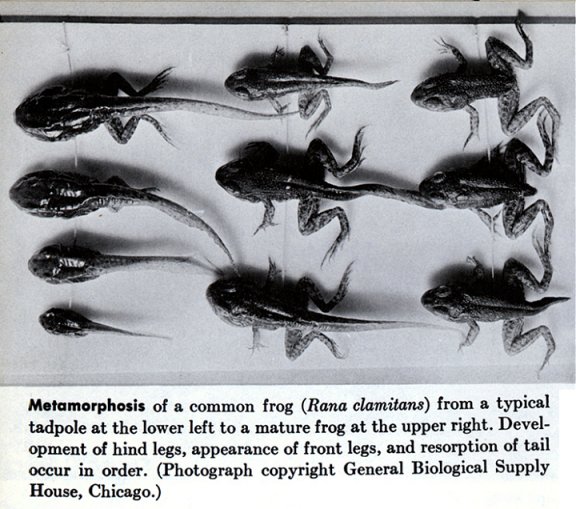
‘Metamorphosis’ is most accurately used by biologists. It describes a rapid and distinctive change in a life form’s physiology. A good example is the one everyone learns at school – the transformation from frog spawn, to tadpole, and finally to frog. But again, it is a word that crops up in everyday conversation, usually to refer to general change and transformation.

So the program could just as accurately (although less romantically) have been called ‘Stuff and Changes to Stuff’. This actually gives a pretty good indication of the content of the films in Black Box 3. Many of them were focused on some material undergoing change – for example the dazzling ‘Crystal World’ by Pia Borg, which features high resolution images of rapidly growing crystals, edited in with found footage from the 1940’s Holywood movie ‘The Night of the Hunter’. However, it was harder to see how other films sat within the theme, until Knowles revealed that the Matter and Metamorphosis of the program title could also refer to the literal film itself.

A recurring concept for Knowles when selecting a program is the development of a ‘dialogue’ between analogue and digital film. Whilst digital cinema may be unsurpassed in its visual detail and clarity, analogue film has a tactility and warmth that cannot be fully imitated. When analogue film is projected, the shutter on the projector has to shut and reopen between each new image. The frame changes 24 times a second, so the audience does not see the screen go black, but none the less the action of the shutter lends a uniquely visceral quality to analogue. There is also the fact that analogue film is just that – film. It is real organic matter, and as such it offers the experimental filmmaker a huge number of opportunities to physically experiment with the medium. A good example is ‘Polytunnels’ by Nicky Hamlyn. To those uninitiated to the world of experimental cinema, this is an exceptionally challenging film. At 23 minutes in length, it was by far the longest in the program. It features lingering black and white shots of a polytunnel farm, devoid of people, voiceover or soundtrack. The images were often jarringly edited with flashing lights and a flickering strobe effect. This was hard to appreciate until Knowles explained that this effect was achieved ‘in camera’. That is, the film images were spliced and edited in the camera during filming, not in post-production. Hamlyn is in fact making the audience aware of the physicality of the film itself.

To those unfamiliar with film, and the science and artistry that contribute to its creation, the difference between experimental cinema and the video art seen in modern galleries might be unclear. Knowles helped explain the distinction, which might seem vague given the fact that both forms often yield films that are both abstract and anti-narrative. Video art tends to be an extension of a general artistic vision or theme. An artist might have a concept that they wish to explore, and a film may end up being part of that process. The people that view their work might just watch a few minutes or seconds of their film, before moving on to a different part of the gallery.

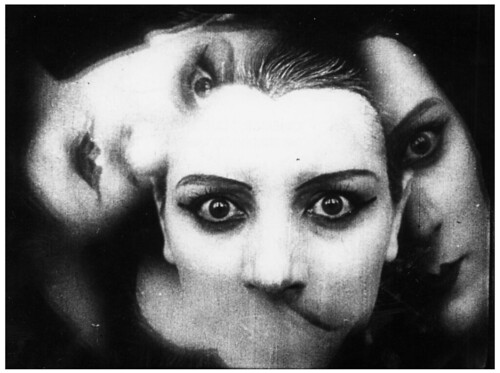
A still from 'Ballet Mécanique' 1923-4, considered one of the
masterpieces of early experimental cinema
Picture: Google images
Experimental cinema, however, is the realm of filmmaker. The film is a work in its own right. The cinema aspect means that the audience are not casual viewers, but are immersed in the film for its entirety. Experimental cinema also has its own rich history, dating back as far as the early 1920s. The films often push the boundaries of what film the medium can do, and draw attention to the material itself. Pere Ginard and Laura Ginès’ ‘Metamorphosis du Papillon’ features footage of a caterpillar emerging as a butterfly from a cocoon. This natural process is compared to the chemical change that occurs when the film itself is burnt, resulting in a dual metamorphosis both on film and to the film itself, with remarkable visual effect.

Often the story behind the creation of the film was as involving as the film itself. The first film, ‘Sou’ by Tatsuto Kimura, was 7 minutes of almost hypnotic footage of changing textures, colours, cracks and crumbles, without music or voiceover. Remarkably, it was actually 7000 rapidly changing close-up colour photographs of 8 individual rocks that Kimura had ground, washed and cracked himself in his studio, over the course of a year.

This illustrates why so many audiences find experimental cinema so alienating, or even aggravating. Knowles used the analogy of a toolbox to describe an audiences’ approach to film. At the cinema, a film is usually judged on the merits of its story, the acting, the cinematography, the score, and the message that it means to convey. Audiences are so used to this that they tend to approach experimental cinema with the same outlook. Consequently, when met with a film that defies standard interpretation, people often feel as though they are being deliberately excluded from some deeper significance, and thus feel irritated and underwhelmed.

So how should an audience approach experimental cinema? It undoubtedly helps to have a little understanding of how films are made. Maybe do a little research into the history of cinema itself. Most importantly though is to stop looking for meaning in the film and approach without preconception and expectation. 

After all, to quote Knowles, ‘Do we have to understand something to experience it?’ Perhaps not, but be prepared that your experience will be unique and not necessarily conclusive. 

Friday, 28 June 2013

What spores can we see at the EIFF?

ASCUS partially abbreviates Art Science Collaborative. An ascus also is an organ in lichen - itself a structure formed by a symbiosis of organisms from two very different kingdoms (fungi and plants), just as we are a symbiosis or artists and scientists. In lichen, the ascus is the place where spores are produced which then colonise new, barren areas of the world.